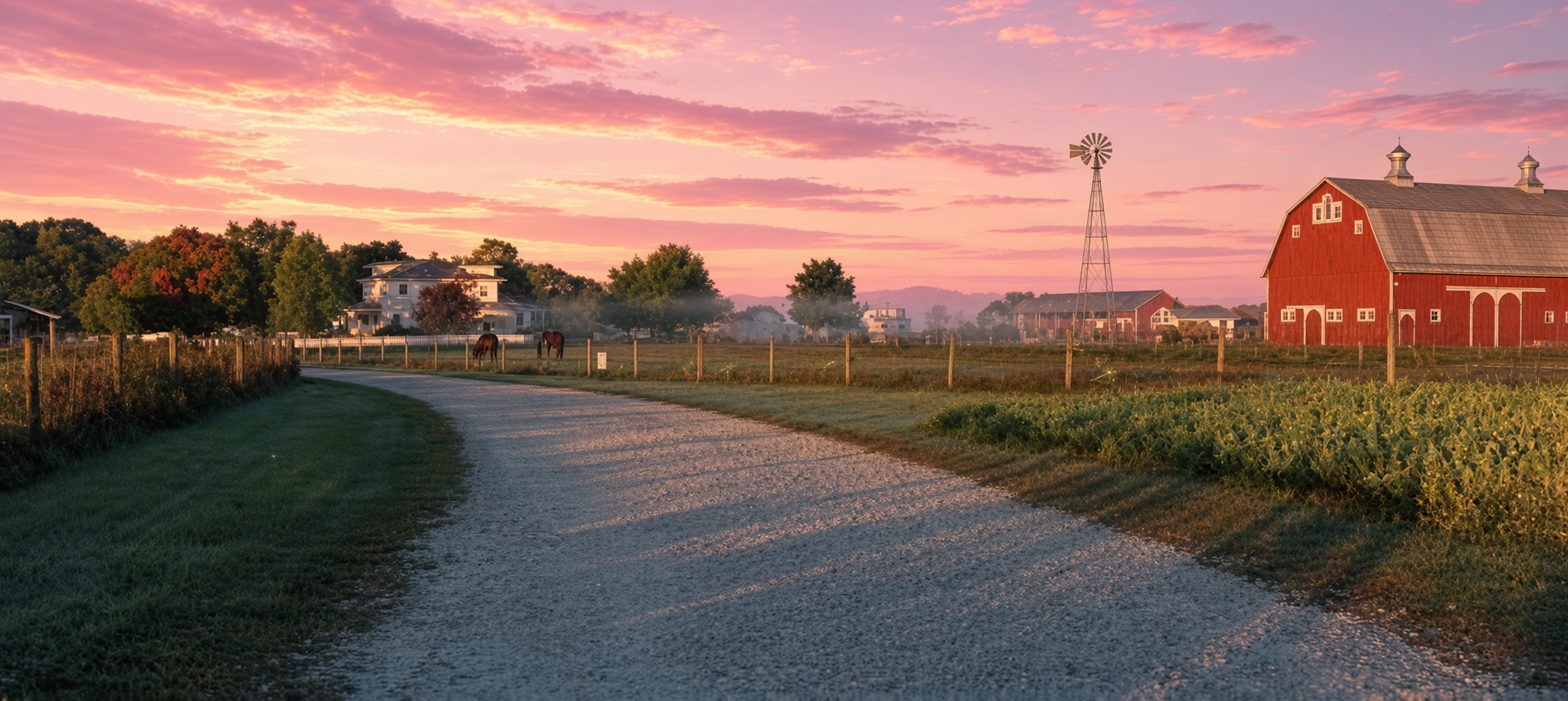

Farmland got a little cheaper on paper. The buildings sitting on it did not.
That is the property-tax story moving through Greene, Martin, Jackson, Washington, Lawrence, Orange, Brown, and the rural edges of Monroe this fall. The January 1, 2026, assessments — the ones that show up on Form 11 notices and drive 2027 tax bills — used new Department of Local Government Finance construction-cost tables. Poultry barns, grain bins, machine sheds, and confinement houses jumped. In some cases they doubled, tripled, or, according to industry testimony in Indianapolis, rose as much as 500 percent.
The dirt under those buildings went the other way. Senate Enrolled Act 1 and follow-on language in House Bill 1210 pushed the statewide agricultural land base rate down from $2,390 an acre toward $2,120. Farm Bureau’s own summary said the agricultural classification as a whole saw about a 12 percent drop in net property-tax liability from 2025 to 2026. Then the buildings got repriced as if every pole barn in Washington County had been built last Tuesday in suburban Indianapolis.
That is not how a working farm experiences a barn.
What actually changed
Indiana does not value most agricultural buildings the way it values a house on Kirkwood. Houses can be “trended” toward sale prices. Ag buildings are costed from state tables, depreciated, then adjusted by a Verified Economic Modifier and a county Location Cost Multiplier. The tables had not been fully refreshed since the 2022 cycle, which still reflected 2021 construction costs — before the post-COVID spike in steel, lumber, labor, and freight.
DLGF Assessment Division Director Barry Wood told assessors in a December 17, 2025, memo that the new schedules use Craftsman national cost data, then apply a central-Indiana modifier and a county multiplier so Jackson County is not priced like Marion County. For January 1, 2026, the VEM stayed where it was set for 2025. The cost pages themselves moved.
Allen County Assessor Stacey O’Day called it a “perfect storm”: tables catching up after a four-year freeze, plus the old Verified Economic Multiplier that had sat at 70 percent from 2014 to 2024 and was brought up toward 100 percent. Duck and turkey barns took the worst of it, she said, because they are large, climate-controlled, ventilated steel buildings — the opposite of a tobacco barn with an earth floor.
Becky Joniskan, president of the Indiana State Poultry Association, took that complaint to the General Assembly’s Agricultural Promotion and Regulation Task Force on September 2. Meat-bird barns, she said, were being costed at $59 to $89 a square foot. Integrators who actually pour the slabs and hang the fans told her a fully outfitted barn looks more like $17 a square foot.
“Whether it’s improving the process by which cost tables are developed by the Indiana Department of Local Government Finance, adjusting percentages in statute, or providing more top-down guidance to local assessors, we need to address the doubling and sometimes tripling of the values of many of our facilities that we saw this year,” Joniskan told the task force.
Indiana Farm Bureau had already heard it from members. Senior Director of Government Affairs Ryan Hoff said reports included 54 percent jumps in Adams County and 60 percent in Morgan and Warrick. One Washington County member — that is this network’s map — saw assessed value move from $340,900 to $915,800, a 169 percent increase.
Hoff’s explanation matches DLGF’s: construction inputs really did get more expensive after the pandemic, and the tables finally caught that inflation. The industry answer is that a 20-year-old broiler house in Martin County is not a new commercial box in Hamilton County, and the tables do not know the difference well enough.
Why this hits the eight counties
Southern Indiana is not a poultry desert and it is not only row crop.
Jackson and Washington sit on the U.S. 50 livestock-and-grain belt. Lawrence and Martin run confinement, bins, and machine sheds off 37 and 50. Greene and Orange still have the mixed operations that look small on a map and large on a tax bill. Brown’s hills hide fewer industrial barns and more of the “ag building that is also a shop.” Monroe’s rural townships — the ones that are not Whitehall Crossing — still have bins and pole barns that got the same Appendix C pages as a Dubois turkey house.
The Location Cost Multipliers in the 2026 residential-and-agricultural schedules put most of this region below Indianapolis: Jackson 91 percent, Brown 94 percent, with neighboring rural counties in the same band. That discount is real. It is also not 169 percent real. A multiplier that knocks 9 percent off a number that was already two or three times local build cost is a rounding error dressed as local sensitivity.
Unlike houses, assessors cannot lean on comparable sales to pull those buildings back toward market-value-in-use. Farm Bureau lobbied for that wall on purpose — so residential boom towns could not trend a machine shed like a kitchen remodel. The wall works both ways. When the cost table overshoots, there is no sales grid to pull it down.
Form 11 notices went out around May 1. Appeals run on a clock. A lot of operators opened the envelope during planting and did not have a spare week to become amateur assessment lawyers.
Who has weighed in — and who has not
The September 2 task force hearing is the official legislative weigh-in so far. The panel was built in House Bill 1003 this year: legislators plus Farm Bureau, Purdue ag and vet med, and commodity seats.
Legislators on that task force:
- Rep. Mike Aylesworth (R-Hebron), chair
- Rep. J.D. Prescott (R-Winchester)
- Rep. Tonya Pfaff (D-Terre Haute)
- Sen. Susan Glick (R)
- Sen. Jean Leising (R)
- Sen. Shelli Yoder (D)
Local House members who cover the eight counties, and what is on the record:
| District | Member | Ground | Public comment on this shock |
|---|---|---|---|
| 45 | Bruce Borders (R-Jasonville) | Greene | None found |
| 60 | Peggy Mayfield (R-Martinsville) | West Monroe / Morgan | None found |
| 61 | Matt Pierce (D-Bloomington) | Monroe city | None found |
| 62 | Dave Hall (R-Norman) | Lawrence / Jackson / Brown fringe | None found on this issue. Hall farms about 500 acres and runs a crop-insurance shop in Bedford. He is the one member of the local delegation who lives inside the spreadsheet. |
| 63 | Shane Lindauer (R-Jasper), retiring | Martin / Dubois | None found |
| 65 | Chris May (R-Bedford) | Lawrence | None found |
| 69 | Jim Lucas (R-Seymour) | Jackson | None found on barns. His broader tax line is phase-out rhetoric, not DLGF Appendix C. |
| 70 | Karen Engleman (R-Georgetown) | Washington fringe | None found |
| 74 | Steve Bartels (R-Eckerty) | Orange / Crawford | None found |
Senate District 44 (Eric Koch, R) covers a wide rural band including Lawrence and Jackson. Washington and Martin have been Eric Bassler’s (R-Washington) ground; he is not seeking another term. No published comment from Koch or Bassler on the 2026 barn tables turned up in the same search.
That silence is the second story. The task force exists because the 2026 session built it. The testimony is already in the record. The people who will vote on a fix in 2027 have mostly not told their own counties whether they think $17 a foot or $89 a foot is the real barn.
Farm Bureau’s 2026 session wins were about land: clarifying agricultural-land parameters after Warrick County members spent a year on the language, and locking the 9 percent capitalization rate so the cheaper acre rate lasts through taxes payable in 2028 — about $50 million in relief on the dirt. Buildings were the leftover. They are now the fight.
What a Southern Indiana operator can still do
The Form 11 is not the tax bill. It is the assessed value that will feed the 2027 bill. Informal review with the county assessor and a formal appeal to the Property Tax Assessment Board of Appeals still exist. Bring the actual build sheet, the integrator contract, the depreciation already taken, and photographs that show a 1998 turkey house, not a 2026 catalog page.
County assessors did not invent Craftsman. They apply the book Indianapolis handed them. Yelling at the courthouse without a packet is theater. Showing the assessor that the table priced a dirt-floor grow-out like a climate-controlled new build is the job.
The policy ask Joniskan put on the table is the one that has to come back in January: either DLGF publishes how the third-party cost survey becomes an Indiana poultry-barn line, or the statute gets a haircut so a replacement-cost table cannot triple a depreciated house that never sold.
Until then, the eight counties will keep paying 2027 bills on 2026 paper that says the barn got expensive while the field got cheaper. The field did not build the barn. The table did.
No thoughts yet — be the first.